
The Tourism Board and Observatur call for full mobility with common guidelines
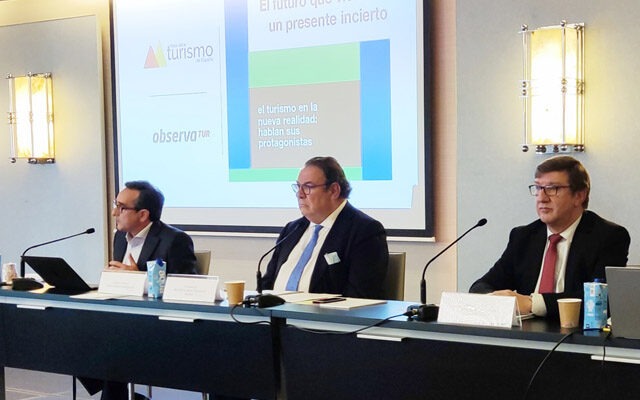
The Mesa del Turismo de España and Observatur, have presented the study “El futuro que viene en un presente incierto. El turismo en la nueva realidad: hablan sus protagonistas”, the first joint project by both institutions to x-ray the current situation of the tourism and travel ecosystem from a multi-segment perspective.
The report was presented by Marcos Franco, founding partner of ReiniziaT and Observatur;Juan Molas, president of the Spanish Tourism Board, and Carlos Abella, secretary general of the same association.
For its elaboration, more than twenty opinion leaders have participated, all of them prestigious businessmen and professionals, members of the Tourism Board and in some cases also of Observatur, who have shared their knowledge and reflections.
According to the conclusions of the study, available in eBook format from the e-mail addresses of both entities, most of the members of the Table are reasonably confident and think that the recovery of the sector will take place from the second half of the year;second semester of this year, after two years that have been very hard, with pronounced drops in the activity, according to their own testimony;
According to their own testimony, these will average around 70% in 2020 and will be close to a 50% decrease in 2021.
However, in order to achieve this longed-for reactivation, it is necessary, they say, to re-establish full mobility, overcoming the barrier of restrictions, if not the "drastic" attitude of many countries. They also call for the existence of a single control framework, with common guidelines and standardized requirements.
The members of the Tourism Board also believe that the Next Generation Funds could be a great opportunity for the sector, although they ask for active participation;n active of the different tourist areas before defining the policies or distributing the aids, so that they are properly articulated and used in an efficient way, since they express their fear that they do not reach the industry as a whole.
They urge to carry out, in addition, a large promotion and communication campaign to transmit confidence and reinforce that Spain is a reliable and safe country.
In his opinion, people are eager to travel again and consider that the brand image of our country has not been affected by the coronavirus crisis.
They also affirm, from their multisectoral perspective, that the situation generated by the health and economic crisis has brought about significant changes in the travel and tourism industry.
The most notable of these are that the customer experience is already being altered by restrictions, and that travel has now become much more complicated and complex.
In this sense, they understand that new habits have emerged in the behavior of travelers, although they do not know if they will last over time.
So, in the new reality, travelers are much more demanding and farsighted, and they demand security, flexibility and greater personalization. They also maintain their desire to seek out the best prices and rates, although they are now delaying their bookings to the last minute.
In the context of corporate travel, experts also identify some variations. Perhaps the most prominent, they say, is the one that anticipates that we may be heading for a hybrid world, at least in the short term.
According to the opinions reflected in this first joint project of the Bureau and ObservaTUR, sustainability is a value that is here to stay, as is digitalization, which will be essential in the post-pandemic era.
Thus, the selection of sites, since the health emergency occurred, is much more careful if possible and more open and sustainable spaces are sought. Likewise, it is assumed that technologies such as the ‘contactless’, the QR codes, the biometrics or real-time information have gained a lot of ground in the new reality.
Maintenance of aids
Entrepreneurs and professionals also demand that, while the restrictions and measures to control mobility persist, the aids to companies in the sector should be maintained.
They expressly speak of the maintenance of the ERTE, of the revision of the ICO funds and of a reduction in the VAT. And that the State and the Autonomous Communities, in addition to offering aid programs, must facilitate the management of European funds.
Despite recognizing the success of the national tourism model, which has led Spain to world leadership, a significant part of the members of the Bureau consider that it is necessary to move towards a new paradigm, with more quality;quality, evolving towards decentralization and sustainability, trying to promote other segments, through complementary experiences to those already existing, or attracting other publics.
Customers who, for example, contribute to the de-seasonalization or to enhance the value of other territories, such as those of the Empty Spain. Or betting, of course, on new markets.