
The AV350 project will reduce the high-speed journey between Madrid and Barcelona to less than two hours
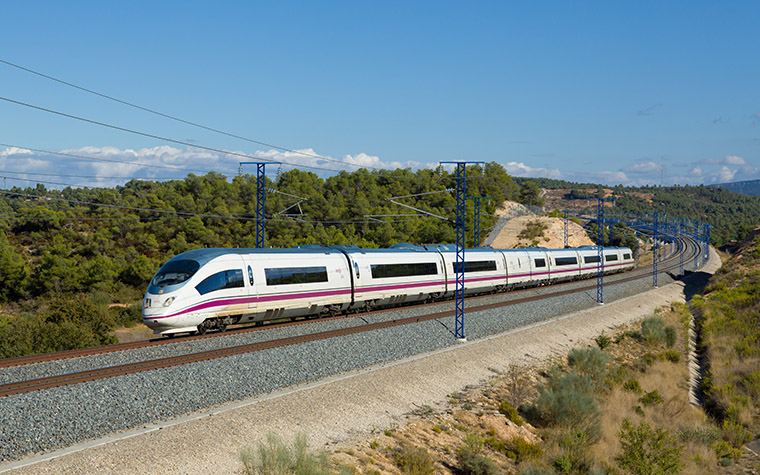
The Ministry of Transport has launched the so-called AV350 project, an initiative that prepares the jump of the Spanish high speed to 350 kilometers per hour and that will have as first laboratory the Madrid-Barcelona corridor. The aim is to shorten the trip between the two capitals to less than two hours.
The Madrid-Barcelona line was originally designed to operate at 350 km/h, although it has never been operated at that commercial speed. The actions announced by the Minister of Transport, Óscar Puente, include important technical modernizations, such as the installation of new aerial sleepers —mdash;more resistant to pressure —mdash;mdash;n;The new aerodynamic pressure-resistant aerotrailers on tunnels and the adaptation of safety and signaling systems to allow continuous circulation at higher speeds. In addition to the specific equipment, the Government foresees a revision of several sections to ensure that the route maintains the structural conditions necessary to operate at this threshold.
The project is structured in several phases. The first phase includes the drafting of technical and feasibility studies over the next 36 months, a timetable that will be the guideline for the subsequent works. The initiative is part of a broader plan that aims to extend this improvement to other trunk corridors of the Spanish network, although the Madrid-Barcelona will be the first to face the transformation due to its traffic volume and its strategic importance for peninsular mobility.
Along with the increase in speed, the Government has announced the construction of two new high-speed stations aimed at improving the system's operational capacity and reinforcing intermodality. In the Community of Madrid, a station will be built in Parla, which will decongest Atocha and Chamartí n and serve as a bypass point for trains crossing the capital without having to stop in the city center. The location, south of Madrid, will also facilitate the redistribution of traffic for services coming from Andalusia, Castilla-La Mancha and Levante, optimizing the entrance to the northeast corridor.
The second station will be built in El Prat de Llobregat, with direct connection to the Cercanías network and Barcelona airport. This infrastructure will allow high-speed trains to connect more easily with national and international flights, something that today is only possible through inefficient combinations from Sants station. The new stop will be key to boosting intermodality and absorbing part of the long-distance traffic without overloading the city center.
The boost to the AV350 has been welcomed by the railway sector, which believes that Spain can be among the countries with the fastest commercial services in the world. However, several experts warn that the —mdash;n —n —n —n —n —n —n —n —n —n should be accompanied by a progressive upgrade of the rest of the corridors if the network is to avoid advancing at different speeds.