
Corporate travel needs clearer and more homogeneous international travel protocols
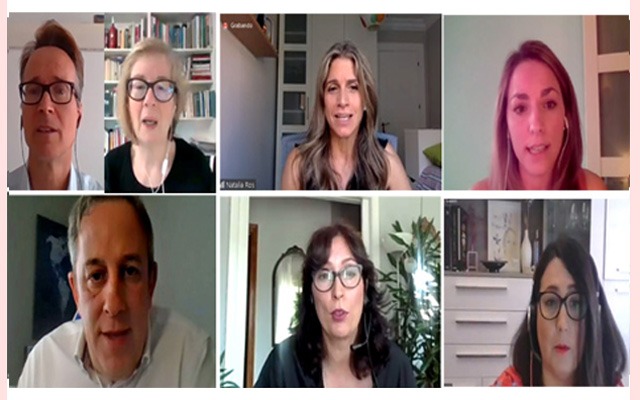
With all the confusion that has arisen during the confinements, companies are calling for homogeneous and clear international protocols to be able to resume their mobility. This was made clear by the travel agencies and travel managers gathered by Gebta at the virtual meeting held on June 19, in collaboration with Forum Business Travel e IBTA.
Gebta.
“There is still a lot of confusion and that does not help companies to move, except those belonging to strategic sectors or with special needs”, commented Alicia Estrada, director of Marketing and Communication at Gebta to open the online session. According to Estrada, "despite the opening of borders within the Schengen territory, each country is adopting its own measures, and this greatly affects the organization of business travel. In addition, reciprocity is normally applied.
The forecasts for the reactivation show that Asian countries are very strict with their measures and controls, but it is to be expected that the great weight of the economy and its relations with Europe will favor flexibility. The countries of the Persian Gulf are slower, especially those with fewer tourism interests. At the moment the most complex situation is occurring in Latin America, which is bad news for Spain, given its special relations with the continent.
The Gebta meeting demanded from Europe “homogeneous measures of control and hygiene, as well as procedures for positive cases, due to the freedom of movement that exists within the EU”. As Estrada warned, "travelers are going to have to get used to a Europe-wide application to monitor people and their health situation. This tool is at a very advanced stage, although there are countries, such as the United Kingdom, that are developing one of their own”.
I also added that the commitment of the EU authorities is to comply at all times with the data protection law and that "the objective is not so much to control movements as to quickly detect the contacts of infected persons".
Marcel Forns, CEO of Gebta, presented the results of a study carried out by GBTA which concluded that in the medium term not all travel will be recovered. According to this work, taking the German market as a reference, 60% of the companies are planning, although mostly in the Schengen area or the EMEA region.
“We must transmit optimism and security. Suppliers and countries are working very hard to offer the maximum guarantees for travel,”, asked Forns. He also stressed that company travel policies should not undergo major changes, because they have long been based on a very tight cost/benefit analysis. Now these criteria will be reinforced, as will the entire security aspect. In fact, risk management will be a fundamental chapter of the policy, not a mere annex," he added.
With regard to the evolution of tariffs, Gebta's general manager stressed that no upward price scenarios are foreseen. “Sí we see, instead, a commercial policy by suppliers with more flexibility, more guarantees, and more possibility of changes, cancellations or change of passenger name in reservations, for example”.
THE VISION OF TRAVEL MANAGERS
Natalia Ros, founding partner of Forum Business Travel, and Begoña Blanco, president of IBTA, were in charge of moderating the round table discussion, which included the participation of Patricia Marcaide, Global Travel Manager at Sibelco, and Verónica Ocaña, travel manager at Grupo Álava.
ForPatricia Marcaide, “all the processes that can be done before starting to travel are fundamental, especially in internal communication. We opened a section on the intranet some time ago dedicated to covid-19”.
The Sibelco travel manager insisted that the travel agency has to be a partner that helps companies to draw up the travel program. Immediate and accurate reporting is essential. In any case, we need more information. The IATA interactive map is fine, but there is a lack of first-hand data on the local situation, the view from embassies, etc.,”, he explained.
Verónica Ocaña, commented that in his company, Grupo Álava, there are people traveling since mid-April, and that this has been possible with a very important information work. We have been growing and adapting to the security that exists at any given moment. According to his criteria, "the agency has been essential in the whole process and continues to be so, not so much in the operational part as in the analytical part".
In line with the initial intervention of Gebta members, Natalia Ros asked “ “a greater harmonization of regulations to generate confidence in travelers, in addition to very clear and accurate information. In these circumstances, agencies have a relevant role as a strategic partner.
All the participants in the round table agreed that the big challenge, in addition to what plane the traveler is going to take or where he is going to stay, lies in how he is going to travel; How is he going to enter a certain country, under what conditions is he going to have breakfast, lunch and dinner, what is he going to do if he falls ill or borders are closed again. The most important thing is that they are clear about what to do in case of any incident. We have so much at stake that there cannot be the slightest doubt”, summarized Patricia Marcaide.
Juan Carlos González, managing director of BCD Travel Spain and president of Gebta, closed the online session by making a spear in favor of TMCs and the value they bring, “since they handle very powerful real-time information and data systems”. Agencies are providing very important support to companies. In addition to the usual services, we have provided assistance on many occasions out of courtesy and a sense of responsibility, without expecting anything in return," he said.