
Real Incentives or Paid Vacations? The Industry Asserts Its Strategic Value at the MICE Hub by Newlink
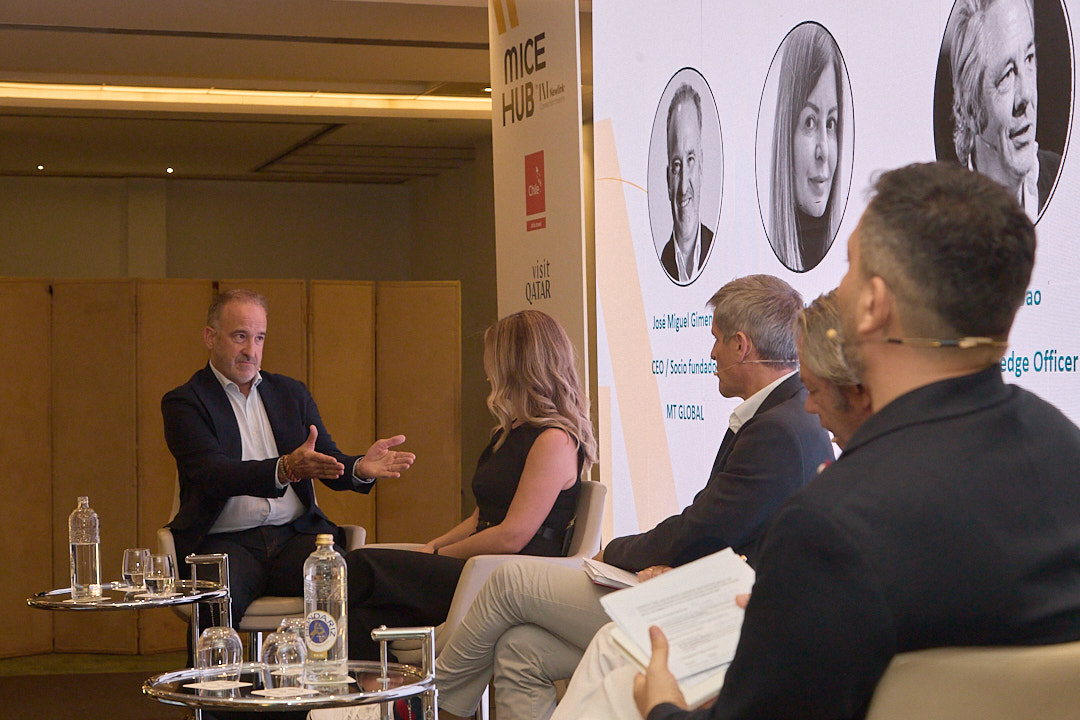
Are we designing true incentive trips or, in some cases, simply paid vacations? ?Do we really measure the impact of events? What role do emotion, personalization, and the little details play?? These were some of the questions that took center stage at the third edition of MICE Hub by Newlink, held at the Hyatt Regency Hesperia Madrid and organized by Newlink Spain in collaboration with Forum Business Travel & Events.
Nearly a hundred professionals participated in an event centered around the roundtable discussion ?The Strategic Value of Meetings and Incentives,? moderated by Alberto Mestre, Route Planner Director of Strategy and founding partner of IDE Marketing, with panelists including José Miguel Gimeno, CEO and founding partner of MT Global; Flavia Mobrici, MICE Product Development & Supplier Relations Manager at Dakari Brand Experience; Ander Bilbao, Chief Knowledge Officer at Be.ON Worldwide; and José San Vicente, Business Development Director for Spain at Amex GBT Meetings & Events.
STRATEGIC INCENTIVES
The discussion began with a fundamental question: why are incentive trips actually organized, and what are they intended to achieve? Ander Bilbao even raised the question of whether it would be more appropriate to refer to ?reward trips? and emphasized the need to define in advance what change one hopes to bring about in the participants. Without that reflection, he warned, there is a risk that the incentive will end up becoming nothing more than a paid vacation.
Such planning also requires a much deeper understanding of the participants. Bilbao pointed out that programs are often designed without sufficient information about the people, their needs, or their motivations, which makes it difficult to achieve a true connection with the company.
José Miguel Gimeno, for his part, emphasized how the profile of the incentive traveler has changed. Today, travelers arrive at their destination much better informed and want to enjoy organized experiences, but also have free time to explore on their own. This evolution requires rethinking overly structured programs and introducing greater flexibility and personalization.
In this context, Gimeno emphasized the value of small details as one of the elements that distinguish a generic incentive from one that is truly well-planned. This idea was shared by José San Vicente, who cautioned that the constant pursuit of the wow factor can lead to neglecting seemingly minor aspects that ultimately have a major influence on the participant?s experience.
EMOTION, CONNECTION, AND TALENT RETENTION
The ability of incentives to generate an emotional connection with companies was another major focus of the conversation. San Vicente emphasized that tapping into emotions helps the corporate message resonate more deeply with participants. He also offered some insight into the scale of events: while large events tend to be the most memorable, small-scale formats can foster a more intense connection between people.
Flavia Mobrici emphasized, in turn, the role of incentive travel as a tool for talent retention, in a context where companies are seeking new ways to recognize, motivate, and build loyalty among their teams.
Personalization is once again a key factor here. Mobrici compared the role of a good travel agent to that of a family doctor versus an emergency room doctor: a professional who knows the client, their expectations, and their history and who, thanks to that ongoing relationship, can better anticipate their needs.
The executive team at Dakari Brand Experience also addressed the role of women in the MICE industry. Although women remain underrepresented in top leadership positions, the executives highlighted their significant influence in areas critical to the sector, such as marketing, logistics, human resources, and sustainability.
MEASURE LESS, BUT MEASURE BETTER
One of the points that generated the most consensus was the need to make progress in measuring the actual impact of meetings and incentives. Participants questioned whether the success of an initiative can be evaluated solely through traditional satisfaction surveys conducted at the end of the trip or event.
For Ander Bilbao, the measurement should go much further and analyze what happens afterward: whether the bond among participants has been strengthened, whether changes occur within the organization, or whether certain business indicators improve. The goal, he argued, should be to provide clients with results that allow them to verify what they have actually achieved with their investment.
José San Vicente agreed that too few resources are still devoted to measuring the impact of events and incentives, and he emphasizedthe importance of maintaining contact after they have ended to obtain feedback that is more useful and to understand their medium-term effects.
José Miguel Gimeno introduced another nuance: measuring more does not necessarily mean measuring better. Faced with the accumulation of data that later proves difficult to interpret or use, he advocated selecting a few KPIs that are well-aligned with the program?s specific objectives.
The lack of post-trip information was also highlighted by Flavia Mobrici as one of the areas needing improvement. Overall, the discussion highlighted a shift in focus: moving from primarily measuring immediate satisfaction to seeking to understand the impact of the experience and the return for the company.
A MEETING POINT FOR THE SEGMENT
The event began with an interview with Natalia Ros Bárbara, co-founding partner of Forum Business Travel & Events, with María de Pereda, Senior Vice President of Tourism at Newlink Spain. De Pereda highlighted the growing strategic importance that the MICE segment is acquiring for destinations, both for those seeking to combat overcrowding and for those looking to improve their positioning.
MICE Hub by Newlink was created precisely with the goal of connecting the various players in the sector, promoting the exchange of knowledge, and identifying new trends. Newlink also works with event and incentive agencies, providing them with up-to-date information on destinations, contacts with local suppliers, familiarization trips, potential funding options, and consulting services.
FIVE DESTINATIONS FOR MICE
The final part of the event offered a tour of five destinations that showcased some of their possibilities for meetings and incentives.
Malta highlighted its proximity, climate, value for money, and size; Chile showcased the enormous diversity of a territory stretching from Atacama to Patagonia, with offerings ranging from wine-tasting experiences to the Polynesian culture of Rapa Nui; Qatar highlighted the profound evolution it has undergone in recent decades without sacrificing its identity, offering opportunities for events at museums and experiences ranging from the Waqif Souk and traditional dhows to the inland sea and mangrove forests. Estonia mentioned some of its strengths, such as the historic center of Tallinn, its historic sites, Tartu, Pärnu, and a close connection to nature and the culture of well-being; while Costa Rica emphasized its hotel infrastructure and connectivity, quality of service, biodiversity, and sustainability.