
Biometric technology is becoming more widespread at airports: the industry is calling for passengers to have a choice
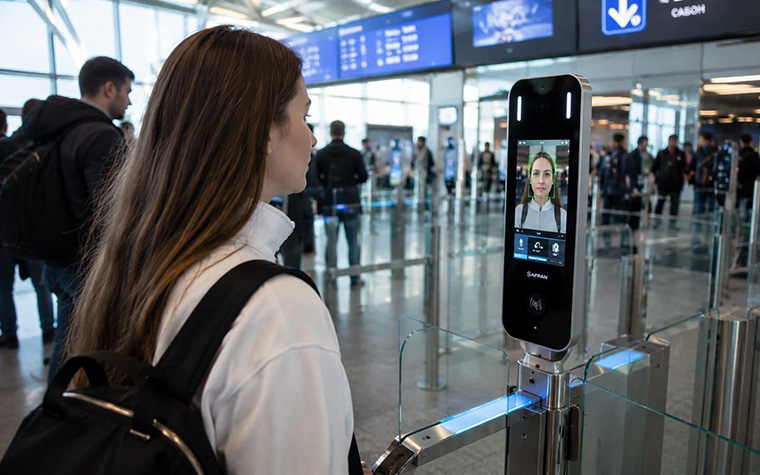
Biometrics is gaining ground at airports as a way to speed up the process of passing through various security checkpoints. Airports, airlines, and technology companies are now calling on the European Union to establish a common framework that facilitates the development of biometrics without compromising privacy. The industry argues that its use should be voluntary, secure, and limited to travel. Above all, passengers should still be able to choose non-biometric alternatives.
The expansion of biomet&at European airports sparks a new debate on how to balance the efficiency of travel with data protection and passengers? freedom of choice.
ACI EUROPE, Amadeus, the International Air Transport Association (IATA), IDEMIA Public Security, and SITA have created the Responsible Biometrics Travel Industry Coalition, an alliance that seeks to influence the European Union?s future regulatory framework for these types of technologies.
The initiative calls for the use of biometric data to facilitate the airport experience to be voluntary and secure, and for travelers to always have an alternative when they do not wish to use it.
The coalition is making its demands in the context of the European Union?s Digital Omnibus, through which Brussels is working to simplify various related digital regulations, including, among other areas, data, privacy, and cybersecurity.
Speed versus privacy
Biometrics makes it possible to replace certain document checks with automated identification systems. Its use can streamline processes such as access to security checkpoints or boarding and help reduce wait times and speed up passenger flow.
Its acceptance among travelers is also growing. According to IATA?s Global Passenger Survey 2025, 50% of passengers had already used a biometric system while passing through an airport, compared to 46% the previous year.
Furthermore, 74% were willing to share biometric information if doing so would spare them from repeatedly showing their passport or boarding pass during processes such as check-in, security, border control, or boarding.
Privacy, however, remains a major concern. Among travelers who were unwilling to share their biometric data, 42% said they would reconsider their position if they had assurances that this information would be protected.
Passengers must retain control
The industry argues that the implementation of these technologies must be accompanied by clear safeguards. These include allowing passengers to decide whether they want to share their biometric data and to request its deletion, as well as providing alternative procedures.
This approach aligns in some respects with the warnings issued by the European Data Protection Board. The European body considers that biometric data is particularly sensitive and that its processing can give rise to risks related to misidentification, bias, discrimination, identity fraud, or impersonation.
In an opinion on facial recognition at airports, the Committee argued that travelers should retain as much control as possible over their biometric data and pointed out the desirability of using less intrusive solutions when they achieve the same objective.
The issue is not limited to consent alone. It also involves aspects such as where the information is stored, how long it is retained, and who can access it.
An increasingly digital airport experience
For business travelers, who are accustomed to frequent travel and repeatedly passing through airport security checks, reducing wait times can have a particularly significant impact.
The digitization of travel is moving precisely toward an experience with fewer physical documents and more automated processes, from check-in to boarding. The challenge lies in ensuring that this increased convenience does not mean sacrificing control over particularly sensitive information.
The coalition advocates for technologically neutral regulation that allows for the continued development of biometric solutions under certain safeguards and with the passenger?s voluntary participation.
It is important to distinguish, however, between these services and legally established border controls, where the processing of certain biometric data may be subject to different obligations. The debate raised by the industry focuses primarily on the solutions that airports, airlines, and technology providers use to streamline the passenger journey.
The future of airport biometrics will thus depend not only on its ability to reduce lines and simplify processes, but also on the trust it builds among travelers. Speed, privacy, and choice are emerging as the three key elements that must coexist in an increasingly digital airport experience.