
Corporate events contributed $1.8 trillion to global GDP in 2025
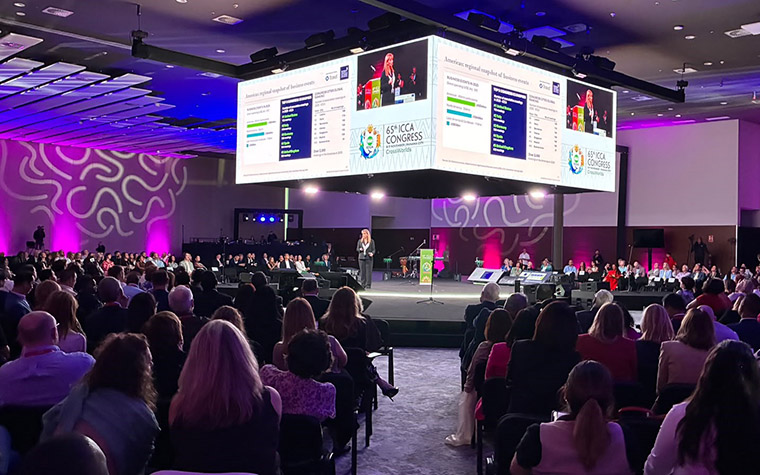
Corporate and professional events contributed 1.8 trillion dollars to global GDP in 2025 and supported 24.2 million jobs, according to a study by the Events Industry Council and Oxford Economics. WTTC President and CEO Gloria Guevara presented these figures during the ICCA Annual Congress, held November 8?11 in Panama City, to highlight the sector?s economic impact and promote policies that foster its development.
The study Global Economic Significance of Business Events 2026 analyzes the activity of conferences, conventions, trade shows, incentive travel, and corporate meetings, which brought together 1,650 million participants worldwide in 2025. Direct spending generated by these events reached $1.3 trillion, while their contribution to global GDP stood at $1.8 trillion and employment linked to the sector totaled 24.2 million jobs.
During his remarks at the 65th Annual Congress of the International Congress and Convention Association (ICCA), held under the theme CrossWorlds, Guevara highlighted the role of professional events as drivers of economic activity and investment in destinations, as well as their ability to generate benefits that extend beyond the dates of the events themselves.
?Business events are much more than just meetings: they are an economic engine that contributes 1.8 trillion dollars to global GDP and supports millions of jobs. Every conference, every convention, and every trade show generates investment, boosts destinations, and delivers benefits that extend far beyond the days of the event,? said the WTTC president.
The American Market
In the Americas, corporate and professional events brought together 454 million participants in 2025 and generated direct spending of 544,000 million dollars. Of this amount, 488,000 million corresponded to North America and 56,000 million to Latin America and the Caribbean, where 118 million participants were recorded.
According to ICCA rankings, the continent hosted more than 2,000 international association meetings. The United States topped the global ranking by country, with 792 meetings, while Buenos Aires ranked 20th among cities, with 91 meetings.
Furthermore, the WTTC?s forecasts for all business travel in the Americas point to spending of 565,000 million dollars in 2026, equivalent to 23% of the region?s total tourism spending. This category includes business travel in general, not just attendance at events.
The United States will account for 81% of this spending, with $458.3 billion, followed by Canada, with $42.3 billion; Mexico, with 14.1 billion, and Brazil, with 12.7 billion. Panama will rank fifteenth in the region, with a projected $1.2 billion.
Priorities for the MICE sector
During her participation in the ICCA Congress, Gloria Guevara identified eight areas of action to improve the competitiveness of the international meetings industry.
Among these, she highlighted the simplification of visa procedures and the mobility of international delegates, as well as improvements in air connectivity and transportation infrastructure. It also advocated for the need to establish specific protocols for prevention and recovery in the event of crises.
Other priorities highlighted included the development of policies that prioritize high-value conferences over mass tourism, the incorporation of sustainable practices, and the training of specialized professionals.
The WTTC president also highlighted the potential of artificial intelligence and digital tools to improve the participant experience, increase operational efficiency, and facilitate the measurement of results. To these lines of action, she added the need to boost investment in venues and infrastructure to strengthen the competitiveness of destinations.