
The 21 keys to business travel in 2017.
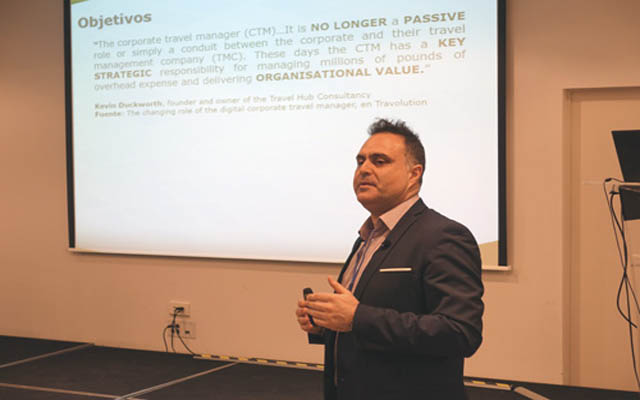
Forum Business Travel brought together in Madrid more than a hundred travel managers from large and medium-sized companies with headquarters or branch offices in Spain, together with leading suppliers from the different segments involved in business travel. The result of their sharing is 21 trends that will mark the management of business travel this year.
The conference, held at the Meliá Galgos hotel in Madrid, featured speeches by Marta Villar, from the Commercial Department of Meliá Hotels International; Eduardo Yunta, director of Corporate Sales at NH Hotel Group;Enrique Martínez, Key Account Manager at Enterprise Rent-a-Car; Sandra Sancho, Marketing Manager at Mytaxi; Mariano Silveyra, General Manager of Cabify in Madrid; Rubén Lázaro, head of Key Accounts at Air Europa; Javier Ruz, Corporate Commercial Director at Healix Spain; Silvia Martín, head of Marketing at American Express Global Business Travel; Ignacio González, National Business Director of Halcón Viajes; Jessica Püttmann, Marketing Director of Diners Club Spain and Fernando Puelles, Head of Business Travel at Amadeus España. These are their conclusions by segment:
ACCOMMODATION
Fares. After years of downturns, hotels are rebounding in profitability. Further price increases are expected in 2017, albeit slight. In Spain, the increase in demand driven by vacationers reinforces this upward trend.
Customer. The commitment to personalization is becoming more and more pronounced. Chains are becoming more enthusiastically involved in the meetings and events (MICE) segment. There will be further improvements in added services, such as technology, security, work spaces, premium services, commitment to the environment…
Agreements.
Accommodation providers with an international presence are betting on global negotiations with their client companies, although applying specific advantages in each local market.
TRANSPORT-A-CAR
Seasonality. The period of high activity in the Rent-A-Car sector is being extended from June to September due to the pressure of demand from the holiday segment, with consequences for Business Travel.
Collaborative economy. Thestart-ups that have emerged in recent years have caused a major disruption in the market, but a significant impact on business travel is not expected, due to the profile of the corporate client, with other needs.
Mobility. Taxi management and chauffeur-driven transfers are going to be placed in the spotlight for companies to improve the control and monitoring of these expenses generated during business trips. Traffic restrictions in large cities favor specialized mobility services.
A&E TRANSPORTATION
Fare breakdown.
A trend that continues and is increasing to provide a service more tailored to the needs of each client. Revenues from ancillary services (ancillaries) of airlines are on the rise. The danger is that this model will become more and more complex.
Airline alliances. Their weight and influence will continue to grow. The optimization of connections they enable, as well as the expansion of the network of destinations and the advantages of shared loyalty programs are seducing travel companies.
Fuel prices.
Subject to numerous uncertainties in the market. Experts are hesitant to make predictions. One element of price containment will be the freezing of airport charges in Spain.
TRAVEL RISK MANAGEMENT
Awareness. Companies with interests outside our country assume that basic travel insurance does not cover all their needs. More demand is expected for true risk consulting services.
Technology.
Mobility applications and tools will enable better responses to incidents. The communication channels between the travel manager and the traveler start to be bidirectional, with a clear improvement in communication.
Good practices.
Good 24/7 service and pre-trip preparation, especially in terms of training and information, as well as safety assessment and planning, are of value. There is also a growing interest in action protocols.
INTERMEDIATION
Traveler experience. Travel agencies and corporate clients are moving towards matching the traveler's experience between private and business travel. The bleisure, or the combination of leisure and business, will increase its followers even more.
Applications. The generalization of technological solutions for mobility will force companies to provide their employees with the means to facilitate their travel, with more flexibility and responsiveness. The use of webservice as a means of technological integration is growing.
Consultancy. Travel agencies will revalue their role as integral advisors. The interest in price may be relegated to the background as intermediary services gain in value and utility. The challenge is to achieve a win-win balance for the company, the traveler and the supplier.
MEANS OF PAYMENT
New solutions. The shock wave of payment alternatives that have been emerging in recent years will continue to grow:
contactless, peer-to-peer solutions, virtual cards, Samsung Pay, Apple Pay, Twyp, Bizum…
Security.
New protocols are expected to ensure the security of transactions. In any case, they go through simplification. For small amounts, validation systems are being eliminated.
Centralized payments.
Traveling companies are looking for systems to centralize tracking and settlement of travel expenses, such as restaurants, parking, cab, wi-fi, etc.
TECHNOLOGY
System integration.
Technology providers will look for new ways to unify approval processes, reservation management, mobility solutions, expense processing and reporting systems into a single platform.
Flexibility and usability.
Improved interfaces to facilitate user processes. The systems will offer more alternatives to make changes, customize itineraries and improve the overall experience.
Automation.
Travel expense management will be integrated into the self-booking tools to control the travel account from the end-to-end model perspective.
Automation. Travel expense management will be integrated into the self-booking tools to be able to control the travel account from the end-to-end model perspective.
Automation.Automation.
Automation.