
The meetings industry grew by 5% in Spain last year, according to preliminary figures from the SCB.
Spain reinforces its leadership in MICE. Business tourism continues to grow and consolidate its importance. This is reflected in the 2025 Meetings Industry Report, prepared by the Spain Convention Bureau (SCB) and the consulting firm Braintrust, which was presented last week at Fitur. The impact of MICE was ?14.83 billion, 5% more than in 2024.
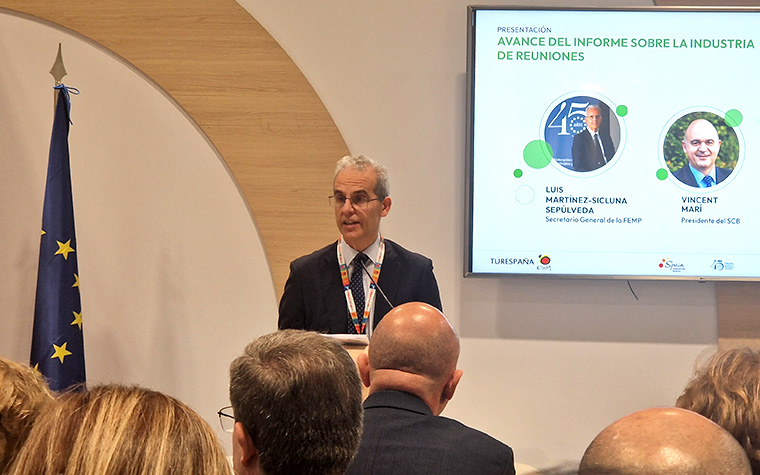
The presentation of the preview of the “2025 Meetings Industry Report," prepared by the Spain Convention Bureau (SCB) together with Braintrust, was one of the highlights of Fitur 2026. Representing the consulting firm, Isabel San Juan revealed provisional figures that point to a year of continued growth for the MICE sector in Spain, accompanied byby Vincent Marí, president of the SCB, and Luis Martínez-Sicluna, secretary general of the Spanish Federation of Municipalities and Provinces (FEMP).
According to this preview, the MICE industry in Spain achieved a turnover of ?14.83 billion in 2025, representing 5% growth over the previous year. Likewise, the number of travelers associated with meetings, conferences, and incentives grew by 10%, and the average daily expenditure per traveler reached ?388.3. These results consolidate Spain as the third country in the world in meeting tourism, a prominent position in the international context.
These provisional figures confirm the positive trend that began in 2024, when the MICE industry closed the year with record revenues of ?14.296 billion, 7% more than in 2023, and with more than 10.5 million travelers in the segment, also exceeding pre-pandemic levels.
TRENDS FOR 2026
During the presentation, Luis Martínez-Sicluna highlighted several trends that will shape the sector's evolution this year:
Slow MICE: a commitment to more sustainable, in-depth experiences focused on the impact for attendees and destinations.
Talent as a critical factor for competitiveness, reflecting the growing importance of professional specialization in event organization.
Specialization by verticals of knowledge, which allows destinations and services to be positioned by specific economic sectors.
Strategic use of data, driving decision-making based on robust analysis of behavior and results.
These pillars not only explain the dynamism of the industry, but also its future challenges, especially looking ahead to 2027 and 2028, for which the report forecasts more moderate but sustained growth.
AN INDUSTRY WITH PROJECTION
In the words of Vincent Marí, the report's findings reaffirm the capacity of meetings tourism to generate economic and social impact, linking local administrations, companies, and destinations in a common value-added strategy. For his part, Martínez-Sicluna stressed the importance of consolidating this leadership through institutional cooperation and the ongoing professionalization of the sector.
The full report, which will be published shortly, will validate these provisional data and identify in greater detail the dynamics by sub-segment, as well as forecasts by destination and type of event, and the strengths and weaknesses of the industry.