
Significant drop in train fares following increased competition
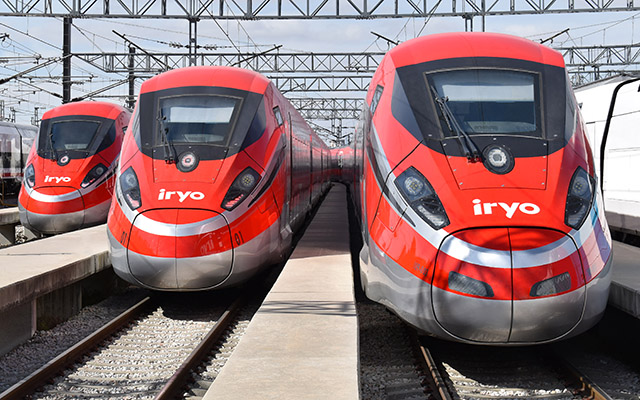
The entry into play of new rail operators from 2019, thanks to the liberalization of the sector, has led to a considerable lowering of fares, according to a report by the National Securities Market Commission (CNMC). On some routes where competition from the three operators is greater, the reduction has been as much as 40%.
The drop in prices is partly explained by the increase in the supply of seats. Average prices fell by around 40% on routes where competition among three operators began in 2022. In the southern corridor, where the entry of competition was more recent, with Renfe and Iryo competing, average prices were reduced by between 10% and 24% depending on the routes.
The ‘Report on the Balance of the Liberalization of Passenger Transport by Rail’ of the National Commission for Markets and Competition (CNMC) also notes that 42% of users of commercial services could choose between three operators for their journeys, and 19%, between two. For the remaining 33%, Renfe continued to be the only option.
Three companies currently operate under four commercial brands: AVE and Avlo (Renfe), Ouigo and Iryo–, with a positive impact of 578 million in 2023. “The consumers were the main beneficiaries of the liberalization, given that 343 million euros corresponded to the benefit of being able to travel more and cheaper thanks to competition between companies”, according to the study.
In any case, Competition states that the joint revenues of the three operators were not even 10% higher than Renfe's revenues in 2019, despite a 60% increase in services.
The CNMC explains that the results were “en línea” with those of other European countriesand recalls that entry into the rail market is "costly and profits cannot be expected in the first exercises, less so aú n with the unfavorable situation of restrictions on mobility - Covid-19 pandemic - and energy costs".
High-speed
Of the 41 million commercial travelers, 31 million used high-speed in 2023, 10 million more than in 2019. Alternative companies captured a total of 10.6 million passengers (26%): Iryo, 14.8%, and Ouigo, 11.2%.
The modal share of rail vs. air in the corridors with competition increased to 85%, with the Madrid-Barcelona route gaining 20 percentage points to 82%.
On routes where competition was incorporatedó earlier and where there are three companiesñías –Madrid-Barcelona or Madrid-Valencia–, the número of travelers prác practically doubledó, from 11.1 million to 19.6 million.
The CNMC highlights that passengers on the Madrid-Valencia route are already more than those on the Madrid-Seville route. By contrast, conventional long-distance services lost more than 2 million passengers between 2019 and 2023, despite improvements in infrastructure.