
Europe's major airlines propose measures to improve service
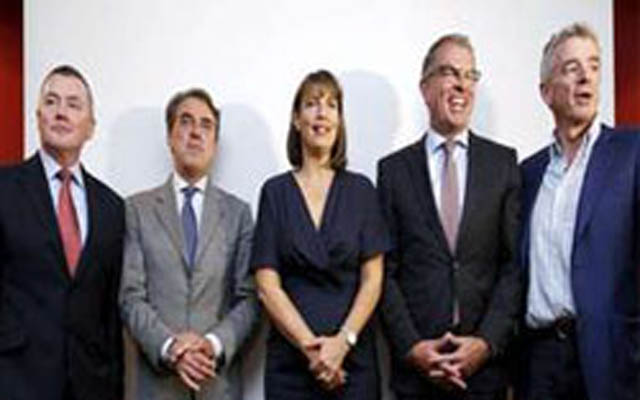
The heads of Europe's five largest airline groups - Air France-KLM, EasyJet, International Airlines Group (IAG), Lufthansa Group and Ryanair - have agreed to work together to collaborate on the development of a new aviation strategy in Europe to support, strengthen the aviation sector and &ldquoacute;ndquo;; have agreed to work together to collaborate on the development of a new aviation strategy in Europe to support, strengthen the aviation sector and “offer passengers lower fares and more choice.
The meeting was in response to a consultation by the European Commissioner for Transport, Violeta Bulc, on a new aviation strategy for Europe. In this way, the five representatives have agreed on a common vision that will bring about a "revolution" in the aviation sector, as well as the "liberalization of the aviation sector";liberalization of the European aviation sector created a generation ago, through the creation of an internal aviation market.
The five airlines have identified four measures that support the Commission's objectives to improve the competitiveness of the aviation industry, both at the European and international level, supporting growth and job creation in Europe and offering consumers more flights and lower fares.
These measures are:
• The development of a new aviation strategy in Europe with a plan for a simple efficient regulatory structure to strengthen the competitiveness of airlines;
Efficient regulation to strengthen the competitiveness of European companies, secure jobs and drive growth through innovation (e.g. Horizon 2020), as well as protect the interests of consumers.
• The reduction of costs at airports that are part of the European Union, ensuring that airport monopolies are effectively regulated. The aim is to ensure that passengers receive the full benefits of the commercial revenues created at airports and that security charges are truly efficient. These measures could be achieved by reforming the Airport Charges Directive.
• Creation of a reliable and efficient airspace by reducing the costs associated with air traffic controllers, ensuring that air traffic controller strikes do not cause disruption to passenger scheduling in Europe. It is also intended to realign the Single European Sky strategy with a focus on the use of new technologies to make efficiency savings; and the use of SESAR funds to drive compliance with the Single Sky framework.
• Stimulate increased economic activity and jobs by creating a appropriate regulatory framework, elimination of passenger taxes as well as unreasonable environmental taxes.
The five CEOs of the aéreos groups —Alexandre de Juniac, Carolyn McCall, Willie Walsh, Carsten Spohr and Michael O'Leary— presented together at a press conference in Brussels at which they confirmed their support for a number of principles and guidelines that should form the basis of the EU's aviation policy. The most important of these, the commitment to safety, reaffirming that these standards are developed on a scientifically based risk assessment.
They also supported the liberalization of the entire industry value chain, a pro-competition policy and regulation within the EU.In addition, they reaffirmed their opposition to state aid to airlines and airports as a general principle. All five agreed that national and European legislation must ensure efficient service provision, including the need to improve operations to minimize the industry's environmental impact. The importance of guaranteeing consumer rights has also been highlighted: national and EU policies need to ensure that they are fairly respected.
On the other hand, the airlines' top representatives have agreed to work together to encourage the Commission and EU member countries to accept the proposed measures. The five airlines agreed to point out that industry representation in Brussels at the moment is not as effective as it could be with six airline representative organizations in each area and agreed to explore alternative forms of representation in the future.
The five airlines agreed to work together to encourage the Commission and EU member states to accept the proposed measures.