
Business Travel Tech highlights the major challenge facing corporate travel: automating processes without losing the human touch
Artificial intelligence, automation, and technological integration are redefining corporate travel management at an unprecedented pace. That was one of the key takeaways from the first edition of Business Travel Tech, the new forum launched by Forum Business Travel & Events to analyze how technological tools applied to business travel are evolving and what the new role of the travel manager will be in this transformation.
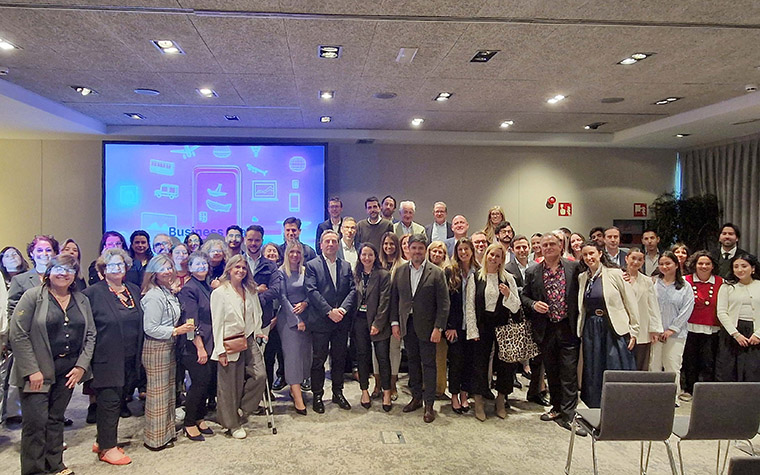
Held at the Ilunion Atrium hotel, the event brought together on May 7 experts, travel managers, and technology providers who agreed on a common idea: the challenge is no longer to incorporate technology, but to know how to use it to gain efficiency without losing the human touch in corporate travel management.
The conference kicked off with a presentation by Miguel Flecha, founder and CEO of Delaight, who explained how artificial intelligence is already adding value to repetitive, high-volume tasks within corporate travel management. Among the main areas of transformation, he highlighted data entry automation, intelligent information management, assisted booking and ticketing, traveler assistance and protection, and reporting and business intelligence.
During his presentation, Flecha emphasized that the real challenge is no longer having artificial intelligence, but understanding where and how to apply it efficiently. The expert also emphasized that the revolution the sector is undergoing is not only technological but also cultural, and it requires redefining the role of the travel manager within organizations. Some industry studies, he explained, even suggest that up to 90% of certain management tasks could eventually be automated in the future.
The second session of Business Travel Tech focused on how technological tools are evolving in the Spanish market and on the travel manager?s new strategic role. Moderated by Óscar García, co-founding partner of Forum Business Travel & Events, the discussion brought together professionals with extensive experience in international corporate travel management.
Antonio Pérez Blázquez, Process & T&E Implementation Manager at Arago, argued that companies must first define their needs and then seek the appropriate technology to meet those objectives, rather than adapting their strategy to the available tools.
For his part, Matthieu Morlet, Travel & Partnership Manager at Horse Powertrain, highlighted the importance of offering a comprehensive and consistent service in a context where corporate accounts are increasingly operating on an international scale.
Borja Neri, Communications Manager & Travel & Events Manager at Maxam, pointed out the challenge of integrating all the technological components to achieve more efficient processes in corporate travel and events, especially in an environment where travelers themselves already use more technology than companies often provide.
Along the same lines, Víctor Mata, Global Travel, Meetings & Events Manager at JTI, emphasized the need to promote training and internal education to truly harness the potential of technological tools and adapt them to the real needs of each company.
ELEVATOR PITCH
One of the most dynamic moments of the day came during the Elevator Pitch session, where several companies presented some of the solutions that are redefining corporate travel management.
Silvia Magdaleno, co-founder and product architect at Silv-IA, presented a tool designed to digitize and transform corporate accommodation bidding processes.
Olga Alemany, Sales Team Manager at American Express Global Business Travel, showcased the new version of Egencia, recently relaunched following a significant investment in technological development and aimed at simplifying processes, improving the traveler experience, and incorporating artificial intelligence capabilities.
Ignacio González, CEO of Consultia Business Travel, also participated and presented Destinux, a proprietary end-to-end solution in which the company has invested 10 million euros and which aims to offer a more personalized and efficient experience in corporate travel management.
For his part, Pere X Galmés, CEO of Ween, explained that the company?s offering is based on agility, 24/7 autonomy, and flexibility, combined with specialized advice from agencies.
In the field of technology distribution, Claudia Bellostas, sales manager at Camelot SBT, defended the independent model of her platform, which is already connected to more than 1,180 companies and ready to integrate with any agency or supplier while keeping management control in the hands of the travel manager.
The session concluded with a presentation by Giovanni Bernardi, Head of Sales at BizAway, who introduced new features designed to provide greater flexibility for corporate travelers, such as Bizzy Flex, which allows bookings to be modified up to three hours in advance, or Wallet, designed to include guests in travel arrangements, all supported by a 100% in-house, human customer service team.